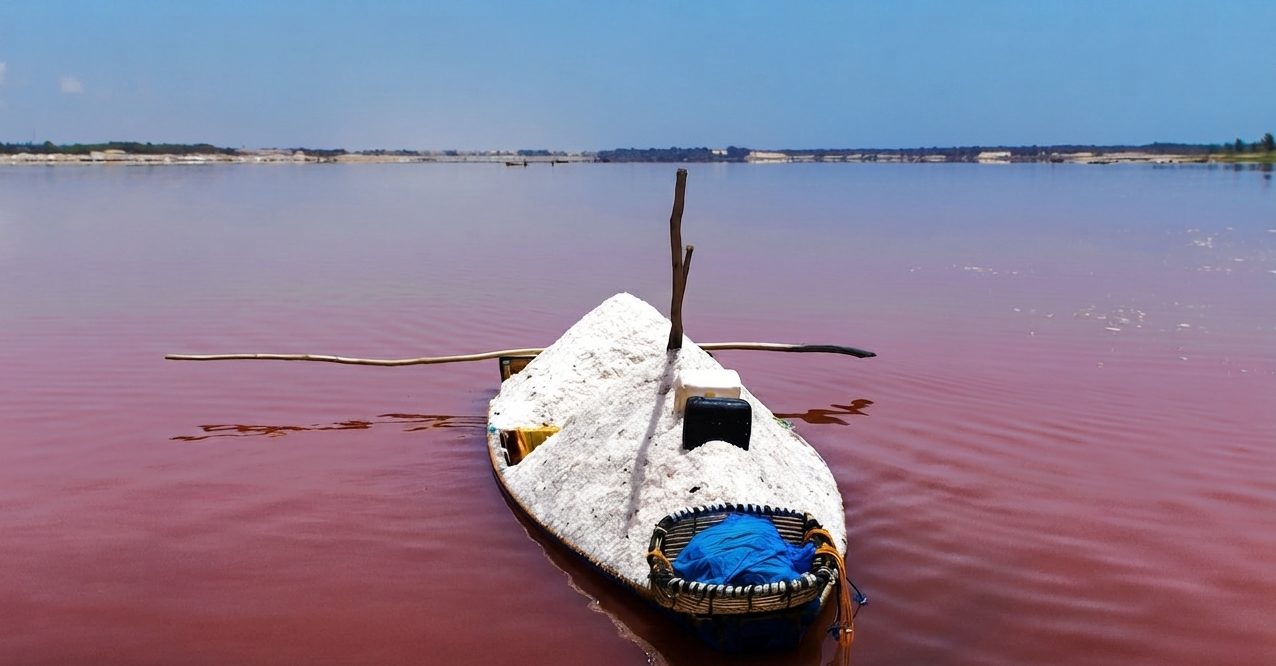
The economic landscape surrounding one of West Africa’s most iconic natural landmarks is finally experiencing a long awaited rebirth. Lake Retba, widely recognized across the globe as the Pink Lake of Senegal, has officially reclaimed its famous rosy pigment and reopened its doors for commercial salt extraction. This milestone marks the end of a deeply challenging period for the local economy in Senegal, which suffered catastrophic setbacks when severe environmental events crippled the delicate ecosystem that thousands of families relied upon for survival.
For generations, the low lying lake situated just northeast of Dakar functioned as a vital engine of regional commerce within Senegal. The waters derived their distinct and vibrant color from microscopic organisms known as Dunaliella salina algae, which thrive exclusively in conditions of intense salinity. Local miners spent their days wading deep into the dense brine to manually scrape valuable mineral deposits from the lakebed, feeding a thriving domestic and international trade. Beyond mineral extraction, the destination regularly attracted thousands of international visitors during its peak tourism windows, supporting nearby hotels, artisans, and transport networks.
Everything changed abruptly during the heavy rains and severe environmental displacement experienced across Senegal. In a desperate move to manage mounting urban water overflow during heavy storms, authorities diverted massive volumes of excess freshwater directly into the basin. Because the water body sits in a low basin, the sudden and overwhelming influx diluted the mineral concentration drastically. The ecosystem shifted overnight, and the salinity levels plummeted below the threshold required for the signature algae to generate their protective pigments, turning the rosy waters into a dull green and halting mineral production entirely.
The financial fallout across Senegal was swift and severe. Approximately three thousand traditional salt harvesters lost their primary source of income practically overnight, while thousands of ancillary workers dependent on transport, commerce, and hospitality faced total destitution. Local community leaders noted that the sudden halt in activity drained millions of francs from the micro economy, leaving families struggling to secure basic daily needs.
Refusing to surrender their livelihoods to circumstance, local associations, small business owners, artisans, and tour operators united to engineer a grassroots rescue operation within Senegal. Community stakeholders successfully raised roughly twenty three million CFA francs, equivalent to about forty thousand United States dollars, to finance heavy industrial pumping initiatives. Volunteers and local workers installed hundreds of meters of specialized piping to actively drain the excess freshwater away from the basin and push it toward the sea. Municipal authorities in Senegal eventually stepped in to bolster the grassroots effort by supplying heavier commercial pumps and steady electricity.
As the trapped freshwater was systematically removed, the natural evaporation cycles restored the water’s high salinity. The microscopic organisms returned, and the iconic pink shade gradually blanketed the surface once more. Earlier this month, community leaders held a traditional ceremony to officially declare the lake open for business. Workers have returned to the water with shovels and boats, while hospitality operators in Senegal prepare for the upcoming return of seasonal tourists. The revival stands as a powerful testament to community resilience and proves that localized economic determination can successfully overcome major environmental crises.
Boardroom Voices Africa Insight
The revival of Lake Retba underscores the profound vulnerability of localized African micro economies to environmental disruptions, while simultaneously highlighting the incredible power of community led capital mobilization and grassroots project execution. When formal bureaucratic responses stall, local economic resilience and private stakeholder cooperation can step into the breach to protect vital regional supply chains and safeguard communal wealth.