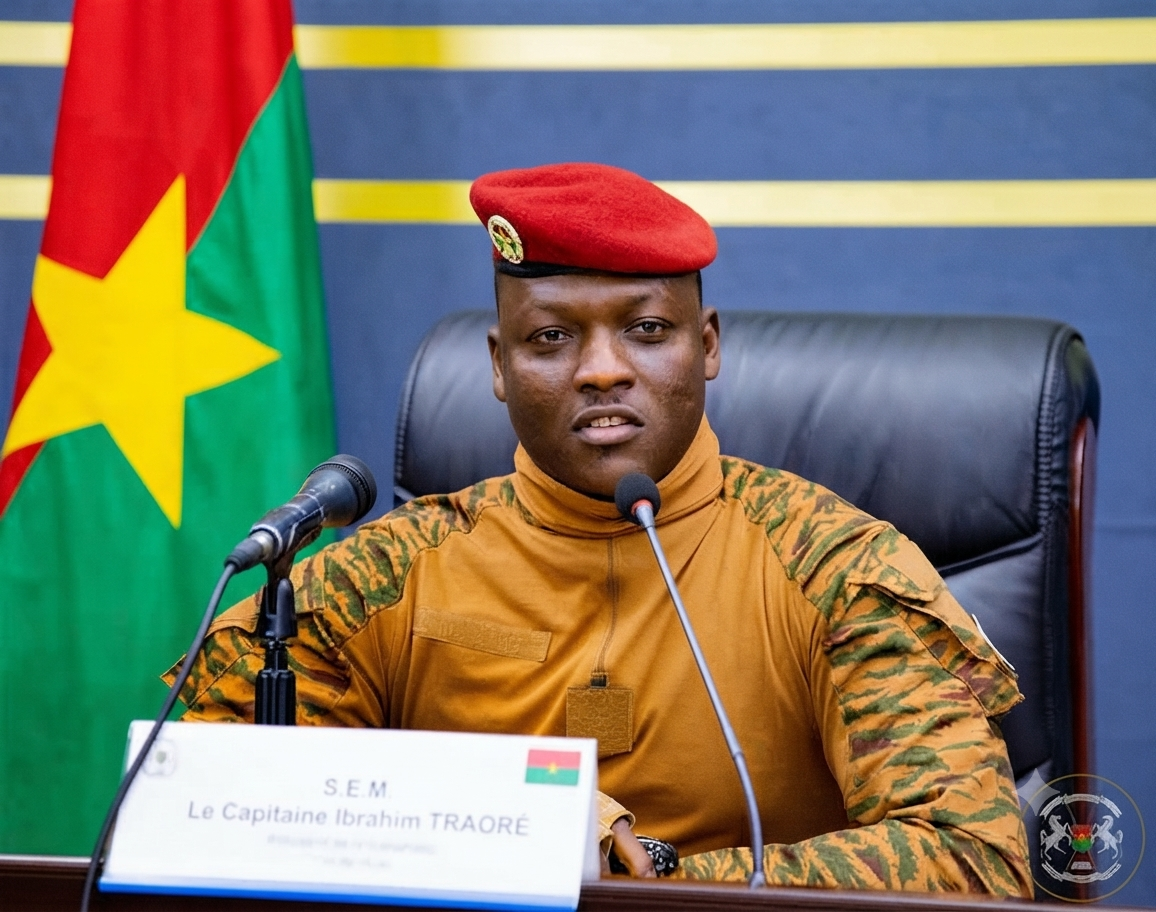
At thirty eight years of age, Captain Ibrahim Traore commands global attention as the youngest head of state on earth. Since seizing power in the September 2022 military takeover that removed Lieutenant Colonel Paul Henri Damiba, his administration has steered Burkina Faso through a turbulent period of political realignment. Nearly four years into his tenure, state officials point to aggressive reforms in resource management, agricultural expansion, physical infrastructure, and regional security. While enthusiastic supporters view these sweeping changes as a long overdue masterclass in national sovereignty, cautious critics continue to sound the alarm over the unelected and increasingly authoritarian nature of the regime.
Central to the government strategy is a relentless push to reclaim ownership of the national mineral wealth. For decades, the country watched its most precious assets leave foreign ports as unrefined raw material. Under Traore, the administration shifted direction by taking direct control of strategic mining operations and building a domestic industrial base. The centerpiece of this industrial pivot is a major state backed gold refinery designed to process massive quantities of precious metal annually, effectively halting the traditional export pipeline to European processing houses. Beyond gold, the government is laying the groundwork to exert tighter domestic oversight over hidden deposits of diamonds, bauxite, nickel, and vanadium, ensuring that future extraction directly fills state coffers rather than external pockets.
This philosophy of self reliance extends far beyond mining into the agricultural sector, which forms the economic backbone for the vast majority of the population. In a televised address delivered on December 31, 2025, the administration announced a historic milestone, declaring that the nation had successfully achieved complete food self sufficiency over the course of the year. State authorities credited this breakthrough to targeted rural investments, including widespread mechanized farming initiatives, heavy distribution of subsidized inputs, and direct administrative backing for local farming networks. Building on this momentum, the 2026 economic roadmap aims to deepen rural resilience through expanded irrigation systems, advanced water storage facilities, localized livestock feed production, and commercial agro processing ventures.
Industrial and infrastructural expansion has moved forward in tandem with these primary sector reforms. The state has broken ground on major commercial projects, including the National Support Center for Artisanal Cotton Processing, alongside new aviation hubs, regional healthcare facilities, and expanded vocational training centers. To finance these ambitious undertakings without falling back into cycles of heavy foreign debt, the administration introduced a massive multi billion franc development plan relying primarily on domestic revenue streams, state enterprise profits, and creative citizen shareholding initiatives.
Security concerns, however, remain the most volatile yardstick by which the administration is judged. Following a decisive break with traditional military allies and the expulsion of French military forces, the restructured national army has launched coordinated offensives to push back against entrenched jihadist insurgencies. Government reports indicate that military campaigns have successfully restored state authority over nearly seventy five percent of the national map, allowing thousands of displaced citizens to return to their ancestral farmlands. Amplifying this regional footprint, Traore assumed the rotating presidency of the Confederation of Sahel States, binding Burkina Faso closer to neighboring Mali and Niger in a unified security and political bloc.
Despite these tangible administrative milestones, the political landscape remains heavily polarized. Domestically, Traore commands intense loyalty from younger citizens, rank and file soldiers, and rural communities who view him as an authentic anti imperialist liberator in the tradition of past revolutionary icons. Regionally, he is celebrated across parts of the Global South as a symbol of defiance against foreign hegemony.
That narrative faces sharp pushback from international monitors and domestic opposition figures. Having seized power through military force, Traore has yet to subject his leadership to a democratic ballot, with current transitional roadmaps pushing potential elections further into the future. The government has weathered multiple reported internal conspiracies and coup plots, illustrating persistent fragility within the military hierarchy. At the same time, international human rights watchdogs frequently cite mounting restrictions on independent media, the harassment of political dissidents, and potential governance risks tied to rapidly nationalized industries. Academic evaluations remain deeply divided, capturing the leader variously as a pragmatic reformer, a populist strongman, or a revolutionary pioneer.
Ultimately, the administration of Captain Ibrahim Traore presents a complex portrait of a nation attempting to rewrite its own destiny. Whether the sweeping gains in food production, mineral refining, and territorial control can survive the test of time, and whether they can be balanced against long term democratic governance, remains the defining question for the future of the Sahel.
Boardroom Voices Africa Insight
From a strategic business and macroeconomic perspective, Burkina Faso’s aggressive resource nationalism offers a fascinating case study in high stakes structural adjustment. While domestic industrialization and agricultural self reliance create localized value chains and reduce import dependency, the overarching reliance on state intervention and military decree introduces high regulatory volatility. For regional investors and foreign enterprises navigating the Sahel, future capital deployment will depend heavily on whether these state led economic experiments can transition from emergency mobilization models into transparent, legally stable market environments.