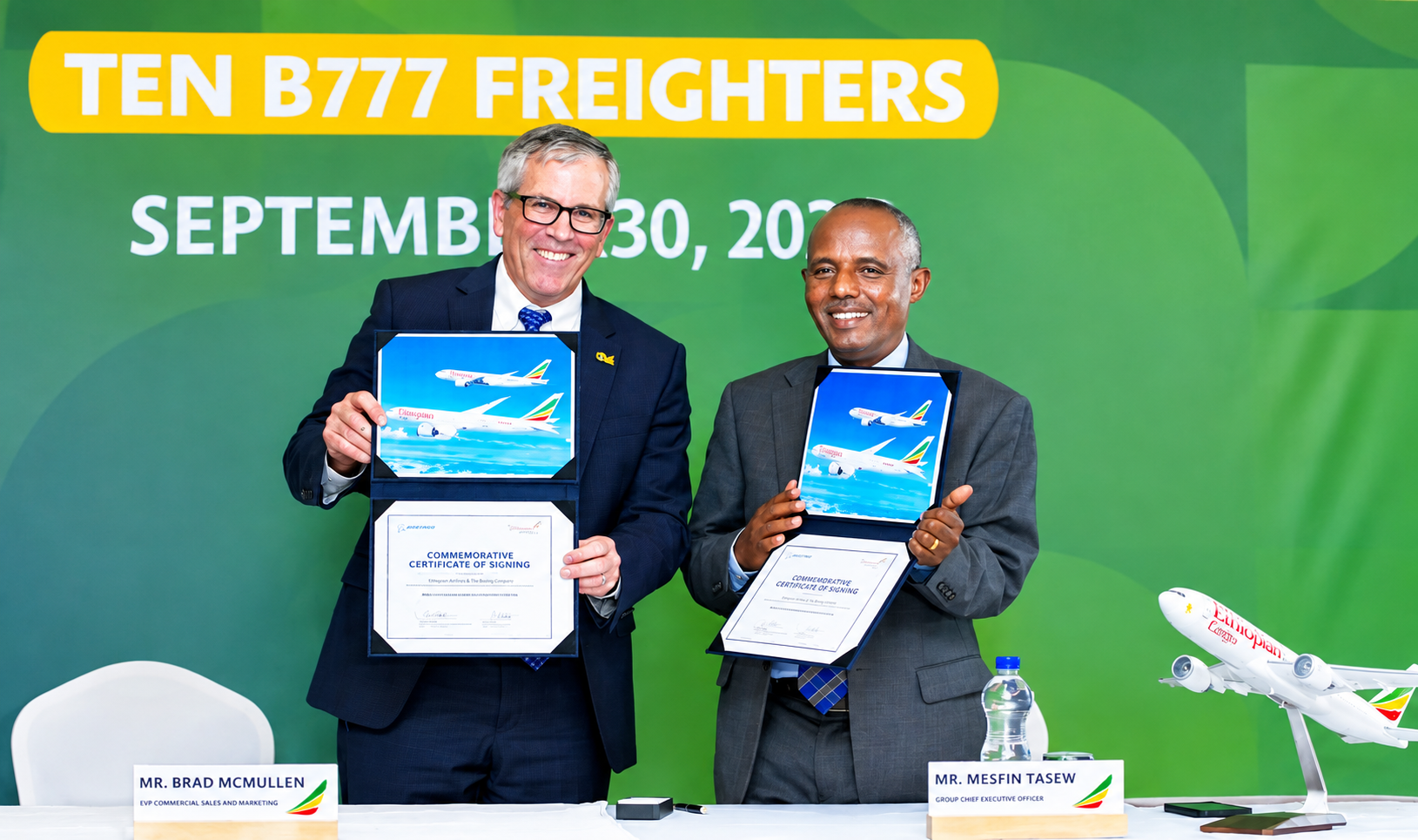
Ethiopian Airlines is making a major bet on the future of African air cargo, signing a deal worth about $5 billion at list prices for 10 Boeing freighter aircraft as it expands its position as a key logistics gateway between Africa and global markets.
The agreement, announced in Addis Ababa on September 30, covers eight Boeing 777-8 Freighters and two 777F aircraft, with options for another eight 777-8Fs.
The deal also makes Ethiopian Airlines the first African airline to order Boeing’s next-generation 777-8 Freighter, adding another milestone to the carrier’s long-standing relationship with the US aircraft manufacturer.
Ethiopian previously became the first African customer for Boeing’s 777X family after ordering eight 777-9 passenger aircraft in 2024.
The two 777Fs are expected to join Ethiopian’s fleet between 2027 and 2028, providing additional capacity while the airline waits for the newer 777-8F.
The eight 777-8 Freighters are scheduled for delivery between 2033 and 2035.
The staggered deliveries reflect the different stages of the two aircraft programmes. Boeing expects the 777-8F to enter commercial service around 2029, although the broader 777X programme has experienced delays.
Ethiopian’s decision to combine the next-generation aircraft with existing 777Fs gives the airline additional cargo capacity in the near term while positioning its fleet for longer-term growth.
The 777-8F is designed to carry more cargo while improving efficiency compared with the current 777F.
The aircraft has a maximum structural payload of about 118 tonnes, compared with approximately 107 tonnes for the 777F, and can accommodate 31 main-deck pallets.
Boeing also says the new freighter will deliver improved fuel efficiency and lower operating costs per tonne while producing a smaller noise footprint.
Its compatibility with the existing 777F design should allow Ethiopian Airlines to integrate the aircraft into its established cargo operations, including its ability to handle oversized shipments.
The order comes as Ethiopian Airlines continues to scale its cargo business.
The airline transported approximately 897,000 tonnes of cargo during its 2025/26 financial year, representing a 16% increase, while group revenue reached a record $9.1 billion.
Its cargo network now connects more than 70 destinations across Africa, Asia, Europe, the Middle East and North America, giving the carrier a growing role in international supply chains.
Group CEO Mesfin Tasew said the new aircraft would strengthen Ethiopian’s cargo capabilities, support international trade and reinforce Ethiopia’s role as a connection point between African markets and the rest of the world.
The freighter investment forms part of Ethiopian Airlines’ longer-term Vision 2040 strategy, which targets annual cargo throughput of approximately 1.9 million tonnes.
The airline is also preparing for the development of the planned Bishoftu International Airport, a multibillion-dollar project designed to significantly expand Ethiopia’s aviation capacity. At full development, the airport is expected to handle up to 3.7 million tonnes of cargo annually.
Ethiopian currently operates a dedicated cargo fleet that includes 12 Boeing 777Fs, two Boeing 767Fs and four Boeing 737-800 converted freighters.
The Boeing order also comes as aircraft manufacturers compete for a larger share of Africa’s expanding air-freight market.
Airbus is positioning its A350F as a next-generation alternative for cargo operators, while Boeing continues to build on the established 777 freighter platform.
For Ethiopian Airlines, the latest order provides additional capacity as global supply chains become increasingly dependent on air freight and as the carrier seeks to strengthen Addis Ababa’s position as a major cargo hub.
The immediate challenge for Boeing will be delivering the new 777-8F on schedule while navigating the certification and production timelines surrounding the 777X programme.
For Ethiopian, however, the strategy is clear: secure additional freighter capacity now while preparing for a much larger role in Africa’s long-term cargo and logistics market.