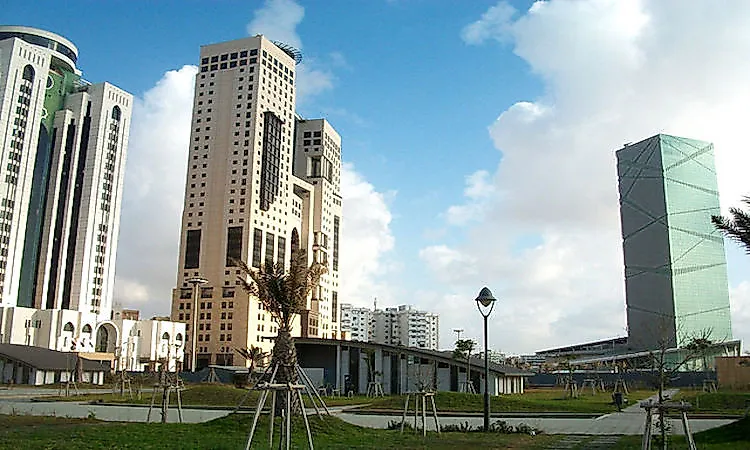
Libya’s business history has been shaped by its abundant natural resources, strategic location on the Mediterranean Sea, and oil industry. Following the end of Italian colonization in 1943 and independence in 1951, Libya was one of the world’s poorest nations, operating a basic agricultural economy with virtually no industrial base. This changed dramatically when oil was discovered in 1956 near the Algerian border. As commercial production began, Libya’s GDP per capita rose from about 40 dollars in the early 1950s to 1018 dollars by 1967.
In the 1970s, Muammar Gaddafi nationalized the petroleum sector and handed the administration of other industries to state organizations. Following a drop in oil revenues in the 1980s, the government introduced reforms to encourage private enterprise. United Nations sanctions imposed in the 1990s were lifted in 2003, prompting the return of foreign investment. However, the 2011 civil war shrank the economy by over 60 percent. While a massive rebound occurred in 2012, subsequent political divisions between rival governments in Tripoli and eastern Libya have repeatedly disrupted oil production.
Today, crude oil, refined petroleum, and natural gas dominate Libya’s exports, with Italy, Germany, and Spain serving as primary trade partners. Meanwhile, the nation relies heavily on China, Turkey, and the United Arab Emirates for machinery, food, and manufactured imports.
Boardroom Voices Africa Insight
Libya’s economic trajectory proves that resource abundance without political stability is unsustainable. For African businesses looking to engage with Libya, the immediate focus remains on navigating its fragmented security landscape. However, the long term potential for trade, renewable energy, and infrastructure reconstruction remains immense once political unification is achieved.