by Kwame Luthando Mensah
According to data released by the Bank of Ghana, export earnings rose significantly compared to $9.2 billion recorded during the same period in 2024, reinforcing Ghana’s position as one of Africa’s most resource-dependent but externally resilient economies.
The performance highlights how commodity cycles—particularly gold—continue to play a decisive role in shaping Ghana’s macroeconomic stability amid global uncertainty and shifting investor sentiment.
Gold Dominates Ghana’s Export Structure
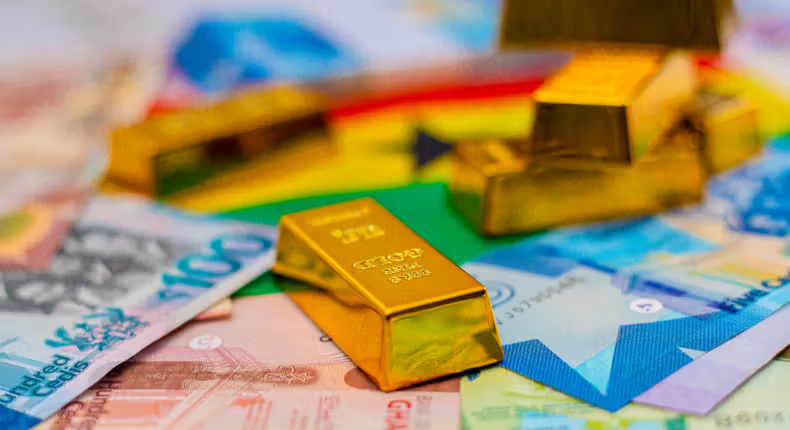
Gold remained the backbone of Ghana’s export earnings, generating approximately $6.8 billion between January and April 2025, up from $5.2 billion in the same period last year.
The surge reflects two key dynamics:
- Rising global gold prices amid economic and geopolitical uncertainty
- Increased investor demand for safe-haven assets
- Strong performance from Ghana’s mining production base
Analysts note that Ghana’s growing reliance on gold underscores both a strength and a structural vulnerability—while it boosts foreign exchange inflows, it also increases exposure to global commodity price fluctuations.
Cocoa and Oil Provide Secondary Support
Beyond gold, Ghana’s export basket remains anchored by cocoa and crude oil, though their contribution has remained relatively stable compared to gold’s rapid growth.
- Cocoa exports generated $1.8 billion, unchanged from the previous year
- Crude oil exports contributed $1.2 billion
- Other export categories accounted for $1.1 billion
While cocoa remains a strategic agricultural export, production constraints and limited value addition continue to cap its growth potential.
Oil revenues, meanwhile, reflect moderate output stability but remain sensitive to global energy price movements and production efficiency challenges.
Imports Rise as Energy Costs Increase
On the import side, Ghana recorded a rise in total imports to $5.8 billion, up from $5 billion in the same period in 2024.
A significant portion of this increase was driven by energy-related imports, with oil imports rising to $2 billion from $1.6 billion year-on-year.
This reflects:
- Higher global energy prices
- Increased domestic energy demand
- Continued reliance on imported refined petroleum products
- Structural gaps in local refining capacity
The widening import bill highlights ongoing external sector pressures, even as export performance strengthens.
Trade Surplus Remains Strong but Under Pressure
Despite rising imports, Ghana maintained a solid trade surplus of $5.2 billion, slightly higher than the $5 billion recorded in the previous year.
This surplus underscores the resilience of Ghana’s external position, supported largely by gold exports and relatively stable commodity inflows.
However, analysts caution that sustained import growth—particularly in energy—could gradually narrow external buffers if not matched by productivity gains and export diversification.
Foreign Reserves Strengthen Further
Ghana’s external reserves position also improved during the period, reflecting stronger export inflows and improved foreign exchange accumulation.
Key reserve indicators include:
- International reserves increased to $14.4 billion in April 2025
- Up from $13.8 billion at the end of 2024
- Gold reserves rose from 18.6 tonnes to 22.3 tonnes
The increase in gold reserves reflects a deliberate central bank strategy to strengthen reserve composition and reduce vulnerability to currency volatility.
Gold-Led Economy: Strength and Structural Risk
While Ghana’s strong reliance on gold has delivered short-term macroeconomic stability, economists warn that heavy dependence on a single commodity exposes the economy to external shocks.
The current boom highlights:
- Strong foreign exchange inflows
- Improved reserve accumulation
- Short-term fiscal breathing space
But also raises concerns about:
- Limited export diversification
- Commodity price dependency
- Vulnerability to global demand cycles
Boardroom Perspective
Ghana’s latest external sector performance reflects a classic resource-driven growth story strengthened by favorable global commodity cycles.
Gold has become the central pillar of the country’s export earnings, reinforcing fiscal stability and supporting reserve accumulation at a critical time.
However, the broader economic signal is clear:
Commodity strength can stabilize an economy—but diversification is what sustains it.
For policymakers and investors, Ghana’s performance underscores both opportunity and caution as the country navigates the balance between resource-led growth and long-term economic resilience.