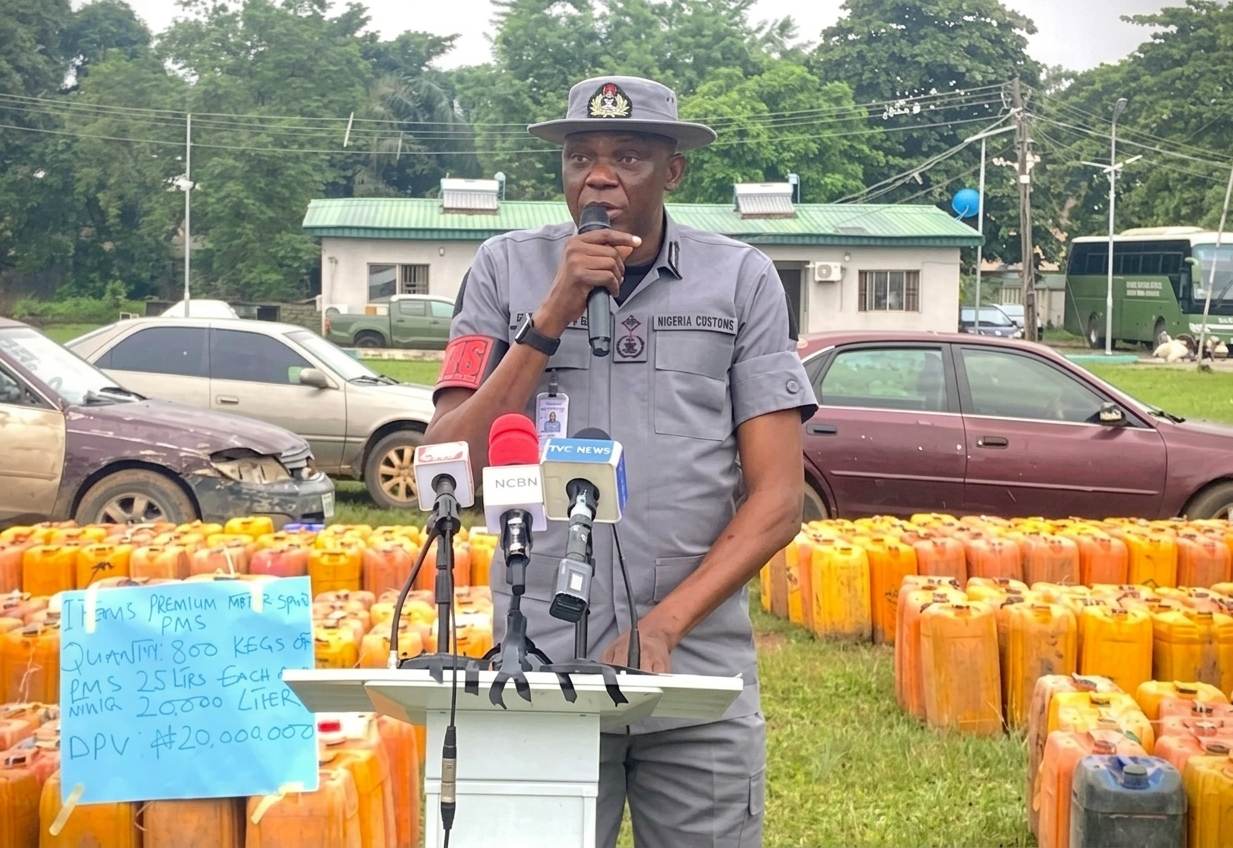
The Nigeria Customs Service has intensified its anti-smuggling mandate by executing high-profile interceptions along key border corridors. Operatives working under national enforcement frameworks, including Operation Whirlwind, have impounded thousands of litres of Premium Motor Spirit and seized multiple conveyance vehicles valued at tens of millions of Naira across critical flashpoints in the Lagos, Ogun, and Adamawa and Taraba regional axes. Acting on real-time intelligence, Customs personnel intercepted coordinated smuggling syndicates attempting to divert fuel earmarked for local consumption into neighboring territories such as the Benin Republic. Beyond curbing product diversion, these seizures emphasize the growing operational efficiency of joint enforcement frameworks involving the Office of the National Security Adviser and the Nigerian Midstream and Downstream Petroleum Regulatory Authority.
The primary enforcement focus remains the interception of unauthorized cross-border fuel diversion and illicit vehicle transport networks, targeting high-risk flashpoints including Imeko, Ilara, Ilaro, Idiroko, Seme-Badagry, and the Mubi Sahuda corridor. These confiscations were executed under the Nigeria Customs Service Act, with suspects now facing legal proceedings that involve potential product and asset forfeiture. Operations were deliberately conducted during high-risk windows, often in the early morning hours, to target clandestine supply networks effectively. During these exercises, operatives seized hundreds of 25-litre jerrycans alongside heavy-duty drums and transport vehicles used to bypass border checkpoints.
Customs leadership emphasized that diverted petroleum products heavily distort domestic fuel supply, cause massive revenue loss, and exacerbate localized fuel scarcity. Therefore, these anti-smuggling exercises aim to preserve price stability and ensure that locally allocated energy resources actually reach domestic consumers. Furthermore, the surveillance and arrest procedures were closely coordinated alongside the Ministry of Justice and the Nigerian Midstream and Downstream Petroleum Regulatory Authority to ensure full legal compliance, rigorous evidence collection, and the transparent public auctioning of recovered inventory where mandated.
Boardroom Voices Africa Insight This decisive clampdown highlights the critical intersection between border security and national economic stability. For businesses operating within the West African sub-region, the persistence of fuel smuggling underscores the urgent need for structural, market-driven pricing models that eliminate arbitrage opportunities across borders. While the enhanced operational efficiency and inter-agency collaboration of the Nigeria Customs Service are highly commendable, reliance on enforcement alone is a short-term fix. Long-term regional energy security and fiscal stability will ultimately depend on harmonizing petroleum policies across neighboring nations to permanently dismantle the financial incentives driving these illicit syndicates.